by Sayantika Chakraborty (University of Florida)
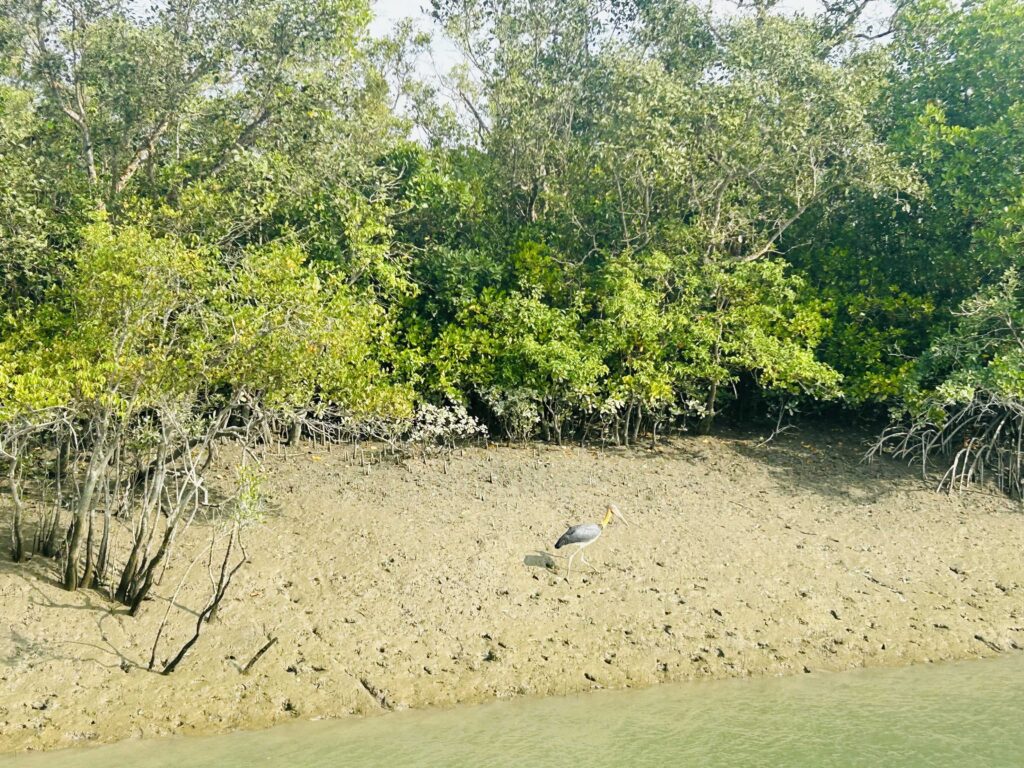
Sundarbans or “beautiful forest” is the world’s largest mangrove forest, spanning across the borders of Bangladesh and India, known for its brackish water, diverse wildlife, especially the magnificent Royal Bengal tigers. Sundarbans is also known for its unique but fragile landscape, ravaged by the onslaughts of human-driven ecological challenges. Water is an untameable force in this mangrove forest, constantly reshaping the land and the life of its inhabitants, where the Indigenous and marginalised populations have always been considered “second class citizens”. This is due to the archipelago being an “underdeveloped” region because of the lack of public work and the government’s unwillingness to provide basic amenities to the people there. Things have become more complicated after the “beautiful forest” was declared a world heritage site by the UNESCO in 1987. With that recognition came the investment of capital and labour in the Sundarbans waterscape—the incessant spilling of toxic waste and oil from the tourist and industrial motorboats into the Sundarbans waterways that poses significant health threats to the local communities.
Women in Sundarbans share a closer proximity to the water, both due to their long-term co-habitation with the mangrove forest, and livelihood choices specific to them. In addition to the toxification of the water due to the government initiative to turn Sundarbans into a popular tourist destination, anthropogenic climate change is exacerbating the mangrove forest’s water contamination problem. For example, sea level rise and frequent cyclones–direct results of the climate change related challenges—are responsible for saline intrusion into the freshwater sources, specifically impacting the women of Sundarbans, who need to stand in the waist-deep saline water for 8-10 hours daily, to collect the prawn larvae. Such prolonged exposure to the contaminated water is wreaking havoc on their bodies, manifested in a multitude of ailments, from chronic skin diseases, irregular menstrual cycle, preeclampsia to the cancers of the urinary bladder, cervix and breast. Climate change challenges combined with water contamination has necessitated a trend of out-migration amidst the Sundarbans populations to the nearby metro cities, such as Kolkata, where the migrants find work as daily wage labourers. However, the ‘choice’ to migrate is different for women in Sundarbans compared to the men, due to the prevalence of a traditional family structure, in which women take on the role of the primary caregiver. Hence, it is a common practice in this mangrove forest for the men to migrate while women tend to stay back. This leaves them with having to figure out ways to address the environmental challenges as well as take care of the family members.
It is against this backdrop of climate change induced challenge in Sundarbans, I discuss the role of Indigenous and other disadvantaged women in asserting equitable and sustainable ecosystem/water conservation practices, in a time when state-led initiatives define the materiality of the environment/water through their privatization and commodification. Keeping this in mind, I explore the restoration of the mangrove forest (a community-driven and community-led effort) by Sundarbans women, that not only acts as a natural barrier against increasingly frequent cyclones, storm surges and soil erosion, but also as an alternate means of women’s livelihood in lieu of collecting prawn larvae from the contaminated water.
My first visit to Sundarbans goes back to 2015. At that time, I was volunteering for an NGO that worked with disadvantaged women who were impacted by climactic disasters such as cyclones and flash floods. It is through my volunteering work, that I became sensitised towards the invisibility of these women’s point of view in the mainstream discussions of climate change. However, before delving deeper into my field work experience, I must clarify my positionality as a non-Indigenous researcher working with the Indigenous/minority women, and not for them. Surely, I am a woman of colour from India and a non-native speaker of English, but I come from a privileged background as I belong to an upper-class, upper-caste household in India. Therefore, in my research the use of a decolonial, feminist framework (borrowing from Linda Smith’s (1999) Decolonizing Methodologies) is imperative, in which my role is that of an ally to the marginalised populations. Based on my long-term exposure and experience working with the Indigenous communities (2015—present) across India, my methods follow a model that has its origin in collaborating with the communities, and the acknowledgement that the climate change narratives belong to these women and are based on their lived experience. This is the most important aspect of working with the Indigenous, or for that matter any minority community, imbibing the basic tenets of an Indigenous Research Methodology/IRM, that upholds mutual trust, respect, responsibility and reciprocity between the researcher and the participants. In this regard, my oral history interview participants are my co-collaborators/research collaborators as they have been a part in every step, from conceiving, designing of the project to giving multiple rounds of feedback on the drafts[1].
I further elaborate on the lived and narrated experiences of the Sundarbans women vis-à-vis climate change, by using the framework of ‘planetary healing’ as developed by Eveline Dürr and Ingo Rohrer (2022). Planetary healing endorses that the “Indigenous practices of healing…connect different scales and address individual as well as collective and environmental dimensions” (Dürr and Rohrer, 2022: 158). Drawing from this, in my project, I interpret planetary healing with references to the climate challenges faced by the marginalised women in India’s Sundarbans, aligned with their aim at conserving the Sundarbans ecosystem through sustainable methods. To further understand the healing practices as adopted by these women, one needs to put it in perspective with the long-standing histories of environmental violence inflicted on these peoples, that goes back to the colonial era. In 1765, the British East India Company, anxious for revenues, brought tribal labourers from far-flung places to Sundarbans for agricultural purposes. Later, additional labourers from various minority populations were brought to this mangrove forest for land cultivation purposes. Most of these indentured labourers ended up settling in Sundarbans and have since called it their home, along with other vulnerable groups migrating to this swamp land from time to time. Therefore, the climate narratives on the healing of the mangrove forest by women in Sundarbans has strong ties with Sundarban’s long-standing legacy of exploitations, from the colonial era to the contemporary extractive activities, in the name of “development”. In this context, the attempted healing of the mangrove forest by the women (for example, through the curation of the mangrove nursery or by using mangrove saplings as shield against coastal erosion) can also be seen as an attempt to decolonise the forest ecosystem from its capitalist exploitations. Planetary healing is tied to a multi-scalar notion of healing in the sense that it connects the individual with the community, environment, and other spheres (Dürr and Rohrer, 2022: 159). Likewise, women-driven initiatives like mangrove nursery in Sundarbans are multi-dimensional where kinship with the nonhuman nature is a driving force, resulting in a collective solidarity between women from marginalised groups, with one common goal of healing the forest.
Now, going back to my first visit to Sundarbans in 2015. I met my first research collaborator Rani Mondal (name changed)[2] in the Patharpratima block, who introduced me to other women in her neighborhood, working on the strengthening the mangrove barriers along the riverbanks. This project is mostly spearheaded by local women, often in partnership with various local and national not for profits, that aims at restoring the mangrove forest. As a part of this project, women collectively raise mangrove saplings and plant them along the riverbanks, thus creating a natural barrier against the soil erosion and environmental degradation. These also act as sustainable livelihood choices for the Sundarbans women, because it helps them move beyond the normative fishing activities, such as collecting the prawn larvae from the toxic water. My encounter such as the one with Rani Mondal has been instrumental for my work, as it sensitised me towards the idea of undertaken by women from the margins, that is rarely discussed in the mainstream rhetoric of climate change.
In the summer of 2024, I went back to Sundarbans, this time as a PhD student and researcher at the University of Florida, with the goal of further unpacking how the Sundarbans women are healing the forest ecosystem. I conducted a series of oral history interviews, primarily in the Gosaba, Satjelia, Patharpratima, and Ghoramara islands, with Indigenous as well as other marginalised women, such as Dalit[3]. Here, it is important to reiterate my earlier point that Sundarbans is considered home by various marginalised populations, ranging from the Indigenous Munda, Oraon to the Dalits and other lower caste people. Hence, my oral history interviews did not focus on one specific marginalised group, instead the aim was to understand how women from diverse communities in Sundarbans are collectively working to save their ‘home’ from the ecological damages and outlining the multi-dimensional and decolonial nature of planetary healing, grounded in the co-existence of different communities and their co-sharing of knowledge.
It is believed that Sundarbans got its name from an abundance of the Sundari tree (scientific name- Heritiera fomes) and the tree has always been treated like a prized possession by the Sundarbans communities. Therefore, it is only apt that the majority of the conservation efforts are directed at the Sundari trees. One of my collaborators during the interview had elaborated on this further by mentioning that Sundari trees have always held a special place in the communities because of its multiple uses. The magnificent Sundari flowers attract bees that play an instrumental role in making the famous Sundarbans honey, highly valued on the global market. Additionally, the root and bark of this tree has medicinal properties. “We often use the medicine made from Sundari gachh (tree) for various ailments, but primarily for indigestion, bloating and diarrhea”, my collaborator commented, “but the tress is rare to find nowadays. In my childhood, whenever I would get sick, my father would summon the kabiraj (a traditional healer) and he would arrive with a potion made out of Sundari tree and I would be better in no time!” Those days are, however, gone, she lamented, as Sundari tree, along with other mangrove species, is declining due to the rapidly increasing environmental challenges.
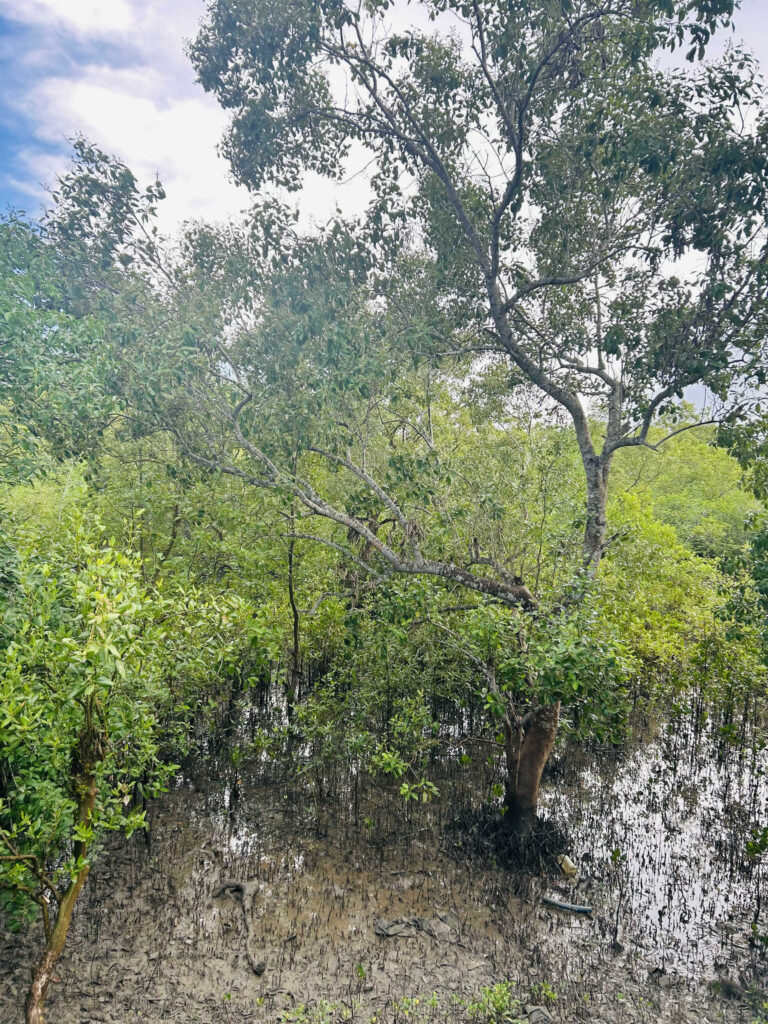
However, Fulmoni Munda from the Gosaba island is hopeful despite the bleak situation. Her husband left for New Delhi, the capital of India, to work as a migrant labourer five years ago, and she has not heard from him since then. She has a ten-year-old daughter and an elderly mother-in-law at home, who needs to be taken care of due to her age-related ailments. Initially, she was barely able to make a living, but then other women in her village introduced her to the mangrove restoration project. She now has a nursery dedicated to the Sundari saplings in her backyard, and she takes care of them as if they were her “own children”. Her daughter frequently assists her in the process. The rumor in her community is that her husband has settled with another woman in New Delhi, but “Life goes on” Fulmoni Munda concludes, and she is confident in her decision of joining other women of the village in doing something meaningful that also provides her with financial stability. “I must also take care of my mother-in-law, because she cannot work anymore. I cannot sit at home and cry over a man who has simply abandoned us”.
Another one of my collaborators, Ruma Maity (name changed) is of the same opinion. She was a survivor of domestic abuse and tried to live with her husband’s violent behavior because she was too afraid to leave. One day, when her husband broke her arm, she decided to leave out of the fear for her and her three-year-old son’s safety. Now, she works hard in the restoration Project, helping other women plant the Sundari saplings along the riverbank, so she and her son can live a better life. Ruma also believes that this is a way of giving back to the forest that has nurtured the local communities for so long. Like other women in her community, she firmly believes that the mangrove forest is not doing well, and it has brought about “diseases that you would usually find in the big cities! But now, you go to ten houses in this area and at least one of the women from those houses is suffering from cancer! Our water has become so toxic!” Like Ruma, another research collaborator’s seventy-year-old mother-in-law can sense a sickness in the air, as she told me, “The forest is not doing well. I am too old, but I grew up here. So, I can feel and understand its rhythm and pulses. For centuries, it has sustained us and now it is time for us to give back”.
And what better ways to give back to the mangrove forest than these efforts at healing its eco-system, spearheaded by the community women? It is also worth noting that the stories of climate resilience, adaptations, and sustainability by marginalised women from Sundarbans are intergenerational, as it involves working towards a just and sustainable solution that includes future generations, through their activities in the mangrove restoration project, instilling in them a desire to nurture the nonhuman (nature) from an early age. This squarely falls along the lines of the concept of planetary healing as practiced by the minority communities, that moves beyond an anthropocentric worldview by bringing visibility to the relationship between the human and the nonhuman nature. Additionally, creating the mangrove nursery and getting involved with the not-for-profits is a great avenue of financial independence for these women, as they have become the sole earners in the family due to the absence of male members.
I believe these stories of female resistance against the toxification of the Sundarbans ecosystem and its water has a twofold purpose. It not only helps the women of Sundarbans generate income (and in turn, independence) as a substitute to the act of fishing while standing in the contaminated water; but also paves way towards the healing of their home—the mangrove forest—as well as their healing from the constraints of the stereotypical gender role. Through this interlinked idea of planetary healing, in my work, I bring the concept to a full circle, that moves beyond the healing of the ecosystem towards the individual and collective healing of the women in Sundarbans.
References
Dürr, Eveline, and Ingo Rohrer. (2022). “Planetary Healing: A New Approach to the Challenges of Climate Change”.Sociologus, 72(22), 157-64.
Smith, Linda Tuhiwai. (1999). Decolonizing Methodologies: Research and Indigenous Peoples (Zed Books).
[1] A blog is not an academic article; hence it is not a space to discuss in detail my theoretical framework and research methodology. However, for more on my positionality as a non-Indigenous ally please refer to these work (by no means exhaustive) that I have consulted-“The Six R’s of Indigenous Research”, “Be an Indigenous Ally”, and “Non-Indigenous Ally.”
[2] As a non-Indigenous/non-minority ally, I made sure to maintain my research collaborator’s choice to remain anonymous in this study. However, if they have been named, it was because they chose to do so.
[3] In India, Dalit women belong to the lowest stratum of the caste hierarchy, in which populations are separated in terms of access to social, cultural and economic capital who could not mix or inter-marry. B.R. Ambedkar described caste as an “enclosed class” who have been segregated based on the sacrosanct notion of purity versus pollution, characteristic of Brahminical Hinduism. The Dalits were the worst victims of this order who were prohibited from being touched and considered outcastes. For more, please see, “Understanding the Disaster Unconscious”, pp. 95.
Cite as: Chakraborty, Sayantika (2026). Climate Crisis and Marginalised Women: Environmental Storytelling from India’s Sundarbans, url: