08/07/2026
Vortrag: Capirona Resiste: Zwischen Goldabbau und der Suche nach wirtschaftlichem Wachstum
Roberto Tunay (ehemaliger Gemeindeleiter von Capirona) und Markos Panayiotou (LMU München)
Gastvortrag im Rahmen des Seminars “Indigenität und der Kampf um Territorium, Souveränität und Wissen” unter der Leitung von Prof. Dr. Michael Bollig
Ort: Institut für Ethnologie, Universität zu Köln
06/07/2026: 9:30 – 11:00 AM
Talk: Planetary Healing: Transformation, (de)colonization and climate change
Eveline Dürr (LMU München), Valeska Díaz Soto (LMU München), Meret Haack (LMU München), Sarah Mund (LMU München), Markos Panayiotou (LMU München), Sophia Siegel (LMU München)
Presentation of the project Planetary Healing at the 1st International GIST Hub Conference.
Location: Katholische Akademie. Mandlstraße 23, 80802, Munich, Germany
More Information: Here
01/07/2026
Vortrag: Raíces que protegen y conservan: comunidades indígenas, cosmovisión del cuidado de la tierra y el mar.
Nancy Guichatureo Barrientos (Comunidad indígena La Mecura Isla Mechuque).
Gastvortrag im Rahmen des Seminars “Indigenität und der Kampf um Territorium, Souveränität und Wissen” unter der Leitung von Prof. Dr. Michael Bollig
Ort: Institut für Ethnologie, Universität zu Köln
24/06/2026
Charla y taller: Tejiendo mar y tierra
Nancy Guichatureo (Communidad La Mecura Isla Mechuque), Maria del Socorro Garcia Hernandez, Reynalda Martinez Flores (Artemali Ocoxal), Meret Haack (LMU-München), Sophia Siegel (LMU-München)
Conversatorio y taller con defensoras del medioambiente de México y Chile.
Lugar: Institut für Ethnologie, Oettingenstraße 67, Raum U133, Raum 123
Más información: Revisar aquí los detalles del evento
22/06/2026 – 23/06/2026
Taller: Encuentro de saberes y miradas decoloniales
Equipo Planetary Healing (LMU-München), Equipo Jaguar, Drohne, Mensch: Indigene Wachsamkeit in Amazonien (LMU-München), Ingo Rohrer, Kervin Saint Pere Huarcaya, Nancy Guichatureo (Communidad La Mecura Isla Mechuque), Reynalda Martínez Flores, María del Socorro García Hernández (Artemali Ocoxal), Juan Luis Camacho Cueva, Rudi Karina Chumpi Chumape, José Andrés Vargas Moya, Marlene Piñarreal Serrano
Taller colaborativo de los proyectos Planetary Healing y Jaguar, drone, human being: Indigenous vigilance in Amazonia, que reunió a investigadores e investigadoras con actores locales de distintos territorios de las Américas.
Lugar: Seidlvilla, Nikolaiplatz 1B, 80802 München
Más información: Revisar aquí los detalles del evento
18/06/2026
Vortrag: Reflections on the Rights of Nature’s Peritos in Ecuador”
Karla García (RCC, LMU-München)
Abstract: The emergence of peritos, or intercultural experts, within Ecuador’s Rights of Nature (RoN) framework posits a novel figure of epistemic mediation. Drawing on ethnographic research, I explore the possibilities and challenges associated with the recognition of locals as experts in the courtroom. Tasks such as translating cultural significances, mediating between worlds, or interpreting other-than-human signs have traditionally been attributed to anthropologists, biologists, or geographers, particularly when presented as expert knowledge in courtrooms. However, the emergence of RoN peritos challenges this notion, positioning them as intercultural experts, grounded on ancestral knowledge and local practices. By tracing perito’s training and the negotiation of their institutional recognition, my research aims to contribute to debates concerning the entanglement of diverse expertises within contemporary institutions as well as the potential inclusion of new forms of epistemic authority in evolving legal frameworks.
Location: Rachel Carson Center for Environment and Society. Leopoldstr. 11a, D-80802 Munich
15/06/2026: 6:00 – 8:00 PM
Vortrag: Verdächtige Subjekte: Vigilanz und Differenzierung im US-mexikanischen Grenzraum
Eveline Dürr (LMU München)
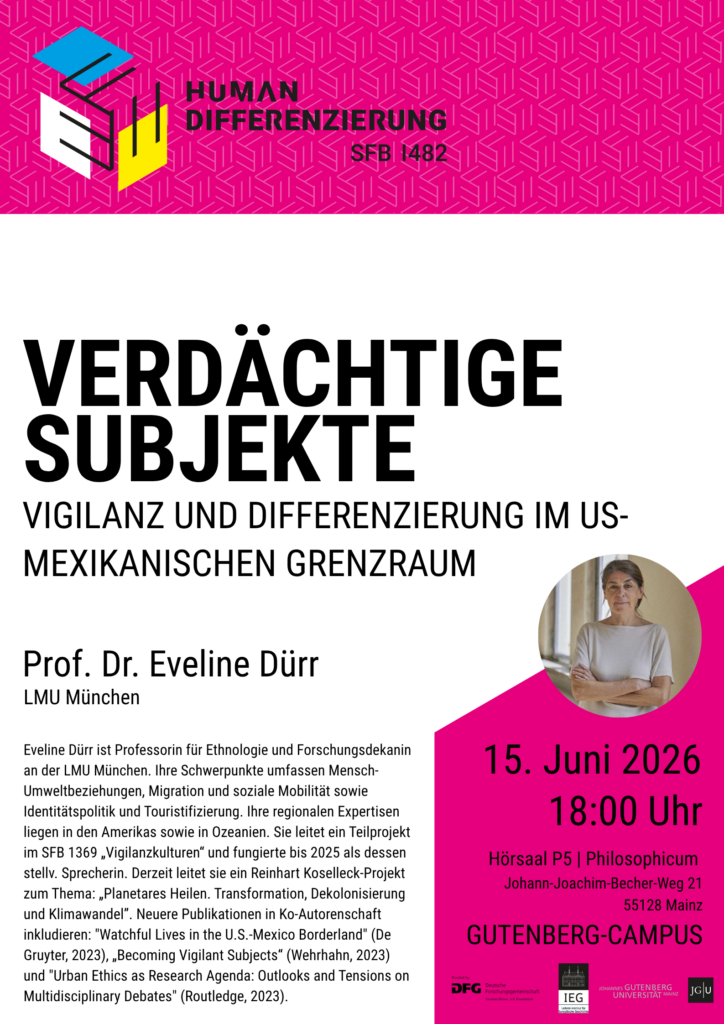
Dieser Vortrag präsentiert die Ergebnisse eines Teilprojekts des SFB 1369 „Vigilanzkulturen: Transformationen, Räume, Techniken“ an der LMU München und reflektiert Vigilanz als eine normativ gerahmte Form der Wachsamkeit, die durch spezifische Wertordnungen motiviert ist und daraus abgeleitete Praktiken der Sicherung und Verteidigung dieser Werte hervorbringt. Im US‑mexikanischen Grenzraum, der von migrationspolitisch aufgeladenen, häufig exkludierenden Diskursen geprägt ist, richtet sich diese Wachsamkeit insbesondere auf rassifizierte Personen sowie deren (vermeintliche) Herkunft, Zugehörigkeit und Legitimität des Aufenthalts. Auf der Grundlage ethnographischer Feldforschung in San Diego, Kalifornien, analysiert der Vortrag, wie diese Personen als potenzielle Bedrohung markiert und als „verdächtige Subjekte“ klassifiziert werden. Infolgedessen werden diese Personen selbst wachsam und integrieren entsprechende Praktiken in ihren Alltag. Darüber hinaus thematisiert der Vortrag die Materialisierung dieser Prozesse und zeigt, wie sich Vigilanzregime in urbane Infrastrukturen, räumliche Arrangements und visuelle Ordnungen einschreiben und dadurch zur politischen Subjektivierung im Grenzraum beitragen.
Ort: Universität Mainz
Mehr Informationen: Hie
09/06/2026: 2:00 – 6:00 PM
Hybrid Workshop: The twin environmental/health crises. Reflections on Indigenous healing processes from Mexico
Laura Montesi (SECIHTI/CIESAS), Juan Mayorga (Independent Journalist)
This workshop is organised through a collaboration between the Planetary Healing Research Group at LMU Munich and the Centro de Investigaciones y Estudios Superiores en Antropología Social (CIESAS) Pacífico Sur, Mexico, and is convened by Sarah Mund, Sophia Siegel and Eveline Dürr.
Location: Oettingenstraße 67, 80538 München
More Information: Here
04/06/2026: 10:45 AM – 12:30 PM
Presentación: Prácticas dancísticas y resistencia anticolonial en los pueblos originarios de Chile
Valeska Díaz Soto (LMU München)
Presentación en el marco del coloquio internacional «Colonialité et Autochtonie dans les Amériques», organizado por la République des Savoirs, CY Cergy Paris Université y Unila
Lugar: École normale supérieure de Paris, 45 rue d’Ulm
29/05/2026: 5:15 – 8:30 PM
Panel: Republics in Crisis – Communities in Movement: Ancestral Knowledge and Territorial Healing in the Face of the Planetary Crisis
Eveline Dürr (LMU München), Valeska Díaz Soto (LMU München), Leticia Durand (UNAM México), Meret Haack (LMU München), Sarah Mund (LMU München), Markos Panayiotou (LMU München), Sophia Siegel (LMU München), Juanita Sundberg (University of British Columbia), Eriko Yamasaki (Philipps-University of Marburg).
Panel session into the Track Environment, Nature and Climate Change of the LASA2026 Congress: Republic and Revolution
Location: FIAP, Europe Level, Jean Monnet Hall. Paris Marriott Rive Gauche Hotel & Conference Center. Paris, France.
19/05/2026: 8:30 – 10:30 PM
Presentación: Entre saberes y creación: artes performativas Mapuche y resiliencia
Valeska Díaz Soto (LMU München)
Presentación en el marco del coloquio internacional híbrido Resiliences, Ecologies et Plurivers: Dialogues entre savoirs, sciences et creation (REPLU). Université de la Polynésie française, Tahiti.
Lugar: en línea
19/05/2026: 6:15 – 7:45 PM
Vortrag: Planetary Spirits in Napo’s Gold Rush
Markos Panayiotou (LMU München)
Vortrag im Rahmen des Amerikas Kolloquium des Instituts für Ethnologie, unter der Leitung von Prof. Dr. Eveline Dürr
Ort: Oettingenstr. 67, Raum L-155
Mehr Informationen: Hier
08/05/2026:
Vortrag: Die Karibikküste Mexikos – Zwischen Artensterben und Heilung
Sarah Mund (LMU München) und Eveline Dürr (LMU München)
Vortrag im Rahmen der 27. Mesoamerikatagung 2026.
Ort: Universität Bonn, Oxfordstr. 15, 53111 Bonn
Mehr Informationen: Hier
19/05/2026: 6:15 – 7:45 PM
Vortrag: Beziehungen im Wandel – Das Potenzial von Transformation und Healing in Lateinamerika
Valeska Díaz Soto (LMU München) und Sarah Mund (LMU München)
Vortrag im Rahmen des Amerikas Kolloquium des Instituts für Ethnologie, unter der Leitung von Prof. Dr. Eveline Dürr
Ort: Oettingenstr. 67, Raum L-155
Mehr Informationen: Hier
21/04/2026: 12:00 – 2:00 PM
Conferencia: Guardianas de La Malinche: voces de resistencia y cuidado del territorio
Sophia Siegel (LMU München) y María del Socorro García Hernández (Artemali Ocoxal)
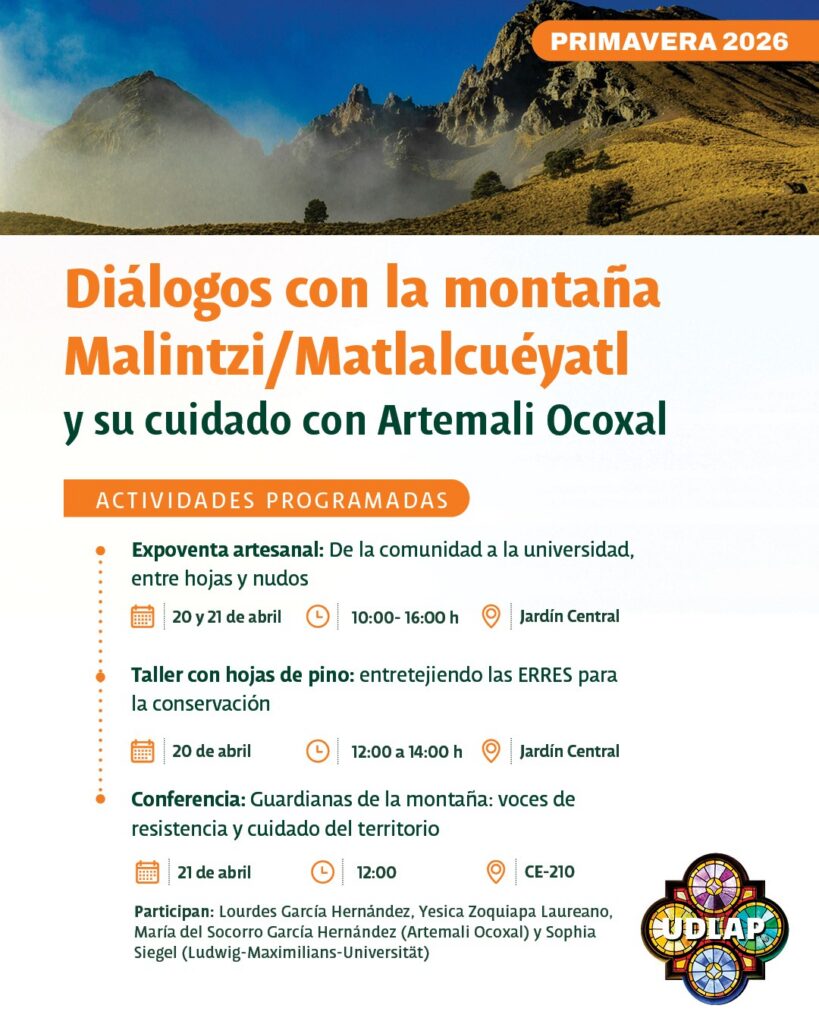
Evento conjunto con las artesanas y activistas ambientales del colectivo Artemali Ocoxal en la UDLAP en Cholula, organizado en colaboración con el Departamento de Antropología y el Departamento de Arquitectura. Además de un taller sobre el tejido de artesanías con agujas de pino, se llevó a cabo una conferencia impartida por María del Socorro García Hernández (Artemali Ocoxal) y Sophia Siegel (LMU Múnich). El enfoque se centró en el trabajo del colectivo para la protección del bosque frente a los desafíos de la deforestación, la contaminación ambiental y el cambio climático
Lugar: UDLAP (Universidad de las Americas Puebla), San Andrés Cholula, Mexico, CE-210
14/04/2026: 10:00 AM
Seminario: O mondo vivido dos povos indígenas da Amazônia
Wolfgang Kapfhammer (LMU München)
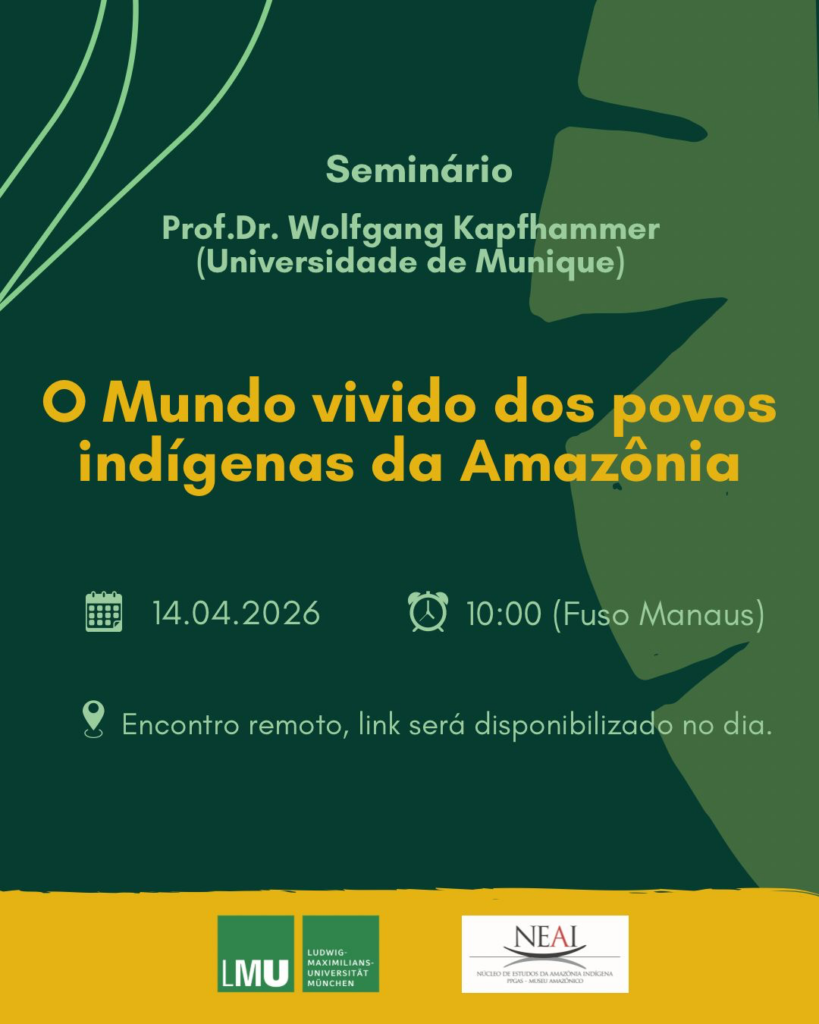
Inauguration session of joint Seminar Institute of Social and Cultural Anthropology, LMU, Munich, and Núcleo de Estudos da América Indígena, UFAM, Manaus. This edition of a longstanding colaboration is dedicated to Indigenous perspectives of climate change in the form of a dialogue between Indigenous students of anthropology of the Colegiado Indígena and German students.
Lugar: Em linha
18/03/2026: 3:00 PM
Charla: La sanación planetaria: el ejemplo del poder Paju en la provincia de Napo
Eveline Dürr (LMU München) y Markos Panayiotou (LMU München)
El Departamento de Antropología, Historia y Humanidades de FLACSO Ecuador organizaron a un conversatorio con Eveline Dürr y Markos Panayiotou sobre la salud planetaria tomando como ejemplo la provincia del Napo. La conversación fue moderada por Michael Uzendoski (FLACSO Ecuador).
Lugar: FLACSO Ecuador, Salón de Afiches (Torre 1, piso 2). Calle La Pradera E7-174 y Av. Diego de Almagro.
19/01/2026: 6:00 – 8:00 PM
Vortrag: Planetary Healing: Perspectives from Latin America
Eveline Dürr (LMU München)
Vortrag im Rahmen der Ringvorlesung Healing, Repair, and Ecological Restoration: Interdisciplinary Dialogues on Planetary Health, des Instituts für Infektionsprävention und Krankenhaushygiene, des Zentrums für Medizin und Gesellschaft (ZMG) und der Exzellenzcluster-Initiative „Future Forests“. Universität Freiburg.
Ort: Max-Kade-Auditorium I, Alte Universität, Bertholdstraße 17, Freiburg.
Mehr Informationen: Hier
15/01/2026: 4:00-5:00 PM
Presentación: Repensar las danzas indígenas: Desafíos y oportunidades desde la Antropología.
Valeska Díaz Soto (LMU München).
Presentación en el 2º Seminario Online en Antropología del Sonido “Etnomusicología e Interdisciplina”, actividad a desarrollarse en el marco de la Escuela de Verano del Instituto de Música UC y patrocinado por la Sociedad Chilena de Musicología.
Modalidad: En línea
Más información: Mayores informaciones y programa aquí
18/12/2025: 12:30 – 1:45 PM
Talk: Ecotourism and Indigeneity in Latin America: Anthropological Perspectives
Eveline Dürr (LMU München).
As part of the interdisciplinary lecture series Thinking, Imagining, and Building Future Environments, Eveline Dürr (Anthropology, LMU) presented a Lunchtime Colloquium lecture exploring the intersections of ecotourism, indigeneity, and environmental relations in Latin America from an anthropological perspective.
Location: Katholische Hochschulgemeinde. Leopolds. 11, 1. OG Saal.
14/11/2025: 2:00 pM
Vortrag: Was tun, wenn die ‚Natur‘ mal tatsächlich ihre Rechte einklagt?
Wolfgang Kapfhammer (LMU München)
Impulsvortrag von Dr. Wolfgang Kapfhammer auf der Fachtagung “Indigene Rechte: Exotische Randnotiz oder Testfall für die Zukunft der internationalen Menschenrechte?” an der Hochschule für Philosophie München.
Location: Hörsaal, Hochschule für Philosophie München.
03/11/2025: 12:00 – 2:00 PM
Was bedeutet Nachhaltigkeit aus einer indigenen Perspektive?
Eveline Dürr & Sarah Mund (LMU Munich)
Open courses during the LMU Sustainability Week.
28/10/2025: 11:00 – 1:00 PM
Planetary healing: transformation, (de)colonization and climate change
Eveline Dürr, Valeska Díaz Soto & Meret Haack (LMU Munich)
Project presentation at the 1st International GIST-Hub Workshop at the Pontifical Catholic University of Chile.
Location: Facultad de Historia, Geografía y Ciencia Política de la Universidad Católica de Chile
06/10/2025: 10:00 AM
Seminario: Crise ambiental planetária: As perspectivas Amazônica e Ocidental.
Wolfgang Kapfhammer (LMU Munich)
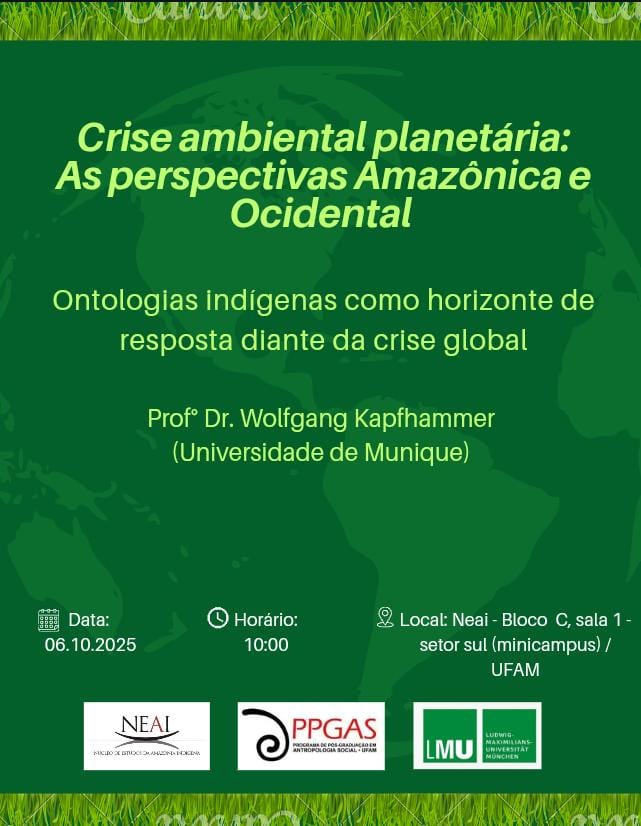
Organização: NEAI | PPGAS/UFAM | LMU München.
30/09/2025: 11:00 – 12:30 & 2:00 – 3:30 pM
Panel: Commoning as a Healing Practice? Potentials, Challenges and Promises
The Panel “Commoning as a Healing Practice? Potentials, Challenges and Promises” at GASCA’s conference, explores Indigenous practices of healing as commoning to address the planetary crises. Healing, as well as commoning, is a relational practice linking different scales, such as individual wellbeing, collective rights, and environmental justice.
Location: University of Cologne.
04/08/2025 – 06/08/2025
The Agency of Other-than-Humans in the Context of Fasting: The Perspectives of Napo Runa Healers
Markos Panayiotou (LMU Munich)
Participation in the 23rd Panel of the XV Salsa Conference: “Engaging with Others in More-Than-Human Worlds: Conceptualizations, Relations, and Interactions”, organized by Francesca Mezzenzana, Jan David Hauck, and Alejandro Erut.
Location: University of Helsinki
More info here: https://salsa-tipiti.org/salsa-conferences/2025-helsinki/
11/07/2025: 6:30 PM
Film: Daughter of the Lake
Screening of the award-winning film Daughter of the Lake at the Rachel Carson Center in Munich.
Organized by Markos Panayiotou and the Decolonial Practices Group.
More info about the film: https://hijadelalaguna.pe/e
08/07/2025: 6:00 PM
Amerikas Kolloquium: Suma Qamaña in the 21st Century: Aymara Traders and Economic Well-being in El Alto, Bolivia
Rubén Darío Chambi (LMU Munich)
*This lecture was part of the Colloquium Wissen verflechten: „Planetary Healing“ im Dialog, chaired by Prof. Dr. Eveline Dürr and will be presented in hybrid format.
Location: Institut für Ethnologie, LMU München. Oettingenstr. 67. Raum L-155
More info here: https://www.ethnologie.uni-muenchen.de/ueber_uns/schwerpunkte/amerikas-neu/amerikas-kolloquium/index.html
01/07/2025: 4:00 – 5:30 PM
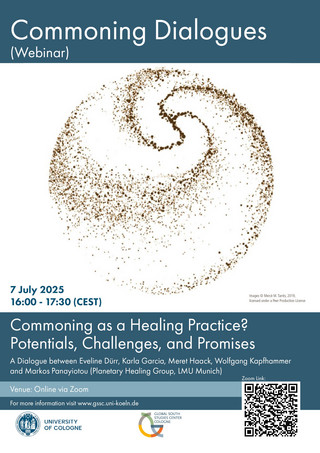
Webinar: Commoning as a Healing Practice? Potentials, Challenges, and Promises
We would like to invite you to our next online Commoning Dialogue on Monday, July 7th, 4pm-5:30pm German time (CET). The dialogue “Commoning as a Healing Practice? Potentials, Challenges, and Promises” with Eveline Dürr, Karla Garcia, Meret Haack, Wolfgang Kapfhammer and Markos Panayiotou (Planetary Healing Group, LMU Munich) will explore commoning within the broader context of healing in the Anthropocene. Drawing on case studies from Indigenous communities, they will show how the commoning of both material and immaterial goods can generate healing effects, such as individual well-being, the recognition of collective rights, and the pledge for environmental justice.
More info here
** An excerpt of the session can be seen in the following video
17/06/2025: 6:00 PM
Amerikas Kolloquium: Transmisión de saberes indígenas a través de las artes
Valeska Díaz (LMU Munich) y Joel Maripil (Ülkantufe, Saavedra, Chile)
Esta sesión busca dialogar sobre el rol de las artes, especialmente la música, en la cultura Mapuche junto a Joel Maripil, Ülkantufe (cultor de la música mapuche), quien ha dedicado su vida a la difusión y transmisión de la cultura mapuche lafkenche a través del ül (el canto).
*This lecture is part of the Colloquium Wissen verflechten: „Planetary Healing“ im Dialog, chaired by Prof. Dr. Eveline Dürr and will be presented in hybrid format.
Location: Institut für Ethnologie, LMU München. Oettingenstr. 67. Raum L-155
17/06/2025: 6:00 PM
Amerikas Kolloquium: Auf verlorenem Posten? Ethnologische Forschung, Antropologia Indígena und dekolonialer Anspruch
Wolfgang Kapfhammer (LMU Munich)
Bei einem Forschungsaufenthalt in Manaus im Rahmen des Projektes „Nosology and Sustainability. Indigenous healing knowledge and sustainable human-environment relations in Northwestern Amazonia“ (angeschlossen an das Planetary-Healing-Projekt) bestand eine Herausforderung darin, als Vertreter einer westlichen Ethnologie mit Vertreter*innen einer Antropologia Indígena zusammenzuarbeiten und in dieser Konstellation eine sinnvolle Rolle zu finden. Eine Antropologia Indígena, also eine von Indigenen selbst erstellte Ethnologie, geht über mittlerweile etablierte Partizipationsmodelle hinaus und dezentriert / dekolonisiert – um nicht zu sagen: delegitimiert – die Außenperspektive westlicher Forscher*innen.
Location: Institut für Ethnologie, LMU München. Oettingenstr. 67. Raum L-155
05/06/2025: 2:00 PM – 7:00 PM
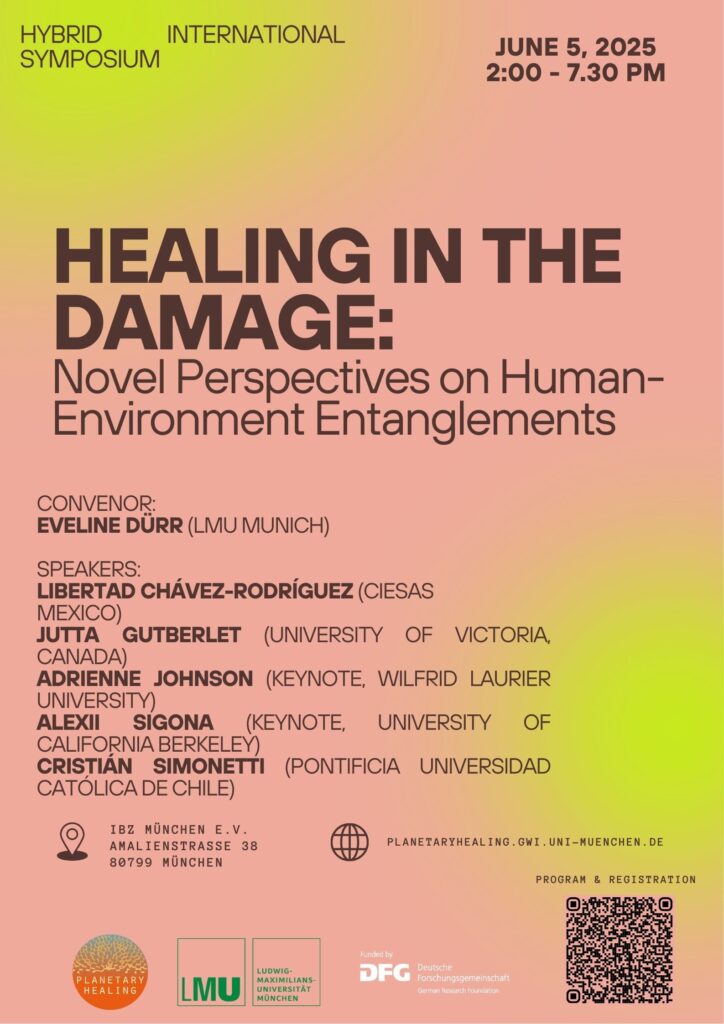
Healing in the Damage: Novel Perspectives on Human-Environment Entanglements
International symposium with Libertad Chávez-Rodríguez (CIESAS México), Eveline Dürr (LMU Munich), Jutta Gutberlet (University of Victoria, Canada), Adrienne Johnson (Wilfrid Laurier University), Alexii Sigona (University of California, Berkeley), Cristián Simonetti (Pontificia Universidad Católica de Chile)
With this symposium, we start the Reinhart Koselleck-Project on Planetary Healing: Transformation, (De)colonization and Climate Change conducted by the planetary healing group at LMU Munich.
Venue: IBZ, Amalienstr. 38, 80799 Munich
03/06/2025: 6:00 PM
Amerikas Kolloquium: Ethnologische Perspektiven auf Heilung
Markos Panayiotou (LMU Munich) & Jhesmin Peña (FLACSO Ecuador)
In this session, we aim to open up a space for bringing past anthropological insights on healing into conversation with our current ethnographic research. Healing practices have occupied a central role in anthropology since the beginning of the discipline. However, the anthropological focus on (medical) systems (cf. Rivers 1915; Leslie 1978; Kohn 2013) has contributed to the reproduction of apolitical, romanticized depictions of non-Western communities and their relationship to the non-human environment. In doing so these perspectives tended to freeze Indigenous communities in an idealized past, ignoring the socioeconomic and sociopolitical changes they have undergone.
By offering recent ethnographic examples from Abya Yala, we aim to illuminate the social transformations of these practices in the context of increased urbanization, environmental changes and catastrophes. Reflecting on anthropology’s past, we will also discuss the new roles and responsibilities of anthropologists within the framework of the “decolonial turn.” (Bejarano Alonso et al. 2019)
Location: Institut für Ethnologie, LMU München. Oettingenstr. 67. Raum L-155
02/06/2025: 4:15 PM – 6:00 PM
Transformation, (De)Kolonisierung, Klimawandel – Einblicke in das Projekt „Planetares Heilen”
Eveline Dürr, Valeska Díaz Soto, Meret Haack, Wolfgang Kapfhammer, Markos Panayiotou (LMU München)
Wir verstehen die mit dem Anthropozän in Verbindung stehenden Umweltfolgen als planetare Krise, die Fragen nach der Zukunft menschlicher Existenz und Bewohnbarkeit des Planeten eine neue Dringlichkeit verleiht. Statt sich jedoch auf Resilienz und Anpassung zu fokussieren, will dieses Projekt einen neuen Ansatz des „planetaren Heilens“ entwickeln. Es rückt indigene und lokale Praktiken des Heilens in den Mittelpunkt, welche verschiedene Ebenen miteinander verbinden und sowohl individuelle wie kollektive und umweltbezogene Dimensionen adressieren. Diese werden explizit zu den Herausforderungen des Klimawandels und zu andauernder Kolonialität, aber auch zu Dekolonisierung in Beziehung gesetzt. Darüber hinaus will das Projekt Potenziale für sozio-ökologische Transformationsprozesse ausloten
*Präsentation im Rahmen des Oberseminars, eine Vortragsreihe des Instituts für Ethnologie unter der Leitung von Prof. Dr. Martin Sökefeld
Ort: Institut für Ethnologie, LMU München. Oettingenstr. 67. Raum L-155
02/06/2025: 2:30 PM
Ponencia: Danza indígena como elemento de transformación social en Latinoamérica
Valeska Díaz Soto (LMU Munich)
Presentación en el panel “05.04 La búsqueda de la justicia social y medioambiental en América Latina representada en las diversas expresiones culturales: literatura- periodismo- cine- música- artes plásticas” del Congreso CEISAL 2025 en torno al tema de la justicia social, medioambiental y climática en America Latina y el Caraibe.
Location: Nation Campus of the Sorbonne Nouvelle, Paris.
More info here: CEISAL 2025
13/05/2025: 6:00 PM
Amerikas Kolloquium: Nature revisited – diálogos transformativos medioambientales en y desde Chile
Meret Haack (LMU)
-> Evento en idioma español
*This lecture is part of the Colloquium Wissen verflechten: „Planetary Healing“ im Dialog, chaired by Prof. Dr. Eveline Dürr and will be presented in hybrid format.
Location: Institut für Ethnologie, LMU München. Oettingenstr. 67. Raum L-155
13/05/2025: 6:00 PM
Amerikas Kolloquium: Scales and Temporalities of Planetary Healing
Eveline Dürr (LMU), Martín Fonck (LMU), Lijuan Klassen (Rachel Carson Center, LMU)
In this presentation, we will explore the concept of “planetary healing” from a conceptual perspective, particularly focusing on the relationship between the planetary and healing through the lens of temporality and scaling practices…
*This lecture is part of the Colloquium Wissen verflechten: „Planetary Healing“ im Dialog, chaired by Prof. Dr. Eveline Dürr and will be presented in hybrid format.
Location: Institut für Ethnologie, LMU München. Oettingenstr. 67. Raum L-155
07/05/2025: 6:00 PM
Keynote Lecture: Touristifizierung von Tepito: Ambivalente Transformation und methodische Praxis in Mexiko-Stadt
Prof. Eveline Dürr (LMU) held a keynote lecture on “Touristifizierung von Tepito: Ambivalente Transformation und methodische Praxis in Mexiko-Stadt” at the annual conference of the „Arbeitskreis Tourismusforschung in der Deutschen Gesellschaft für Geographie (DGfG) e.V.”
More info here: https://www.ak-tourismusforschung.org/wp-content/uploads/2025/03/AKTF-JT-Programm-20250319.pdf
07/05/2025 – 09/05/2025
Umgang mit Ambivalenzen im Tourismus: Jahrestagung des AK Tourismusforschung der Deutschen Gesellschaft für Geographie
Die Jahrestagung des Arbeitskreises Tourismusforschung vom 7. bis 9. Mai 2025 in Freiburg.
More information and registration here: https://www.ak-tourismusforschung.org/veranstaltungen/jahrestagungen/
29/04/2025: 4:15 PM – 6:00 PM
Being Watched: Migrants Returning from the USA to Mexico
Prof. Eveline Dürr (LMU) talked about the (un)told stories of migrants who have returned from the USA to Mexico to a small-town environment. The focus is on the returnees’ strategies to achieve (or not) (re)integration into their community.
Location: Andreasstrasse 15, 8050 Zürich, AND 4.06
More info here: https://www.isek.uzh.ch/en/thedepartment/events/ISEK-Agenda.html?event=61765
23/04/2025
Vortrag: Entre dois campos. Fazendo antropologia como caipira
Vortrag von Dr. Wolfgang Kapfhammer
Ort: Programa de Pós Graduação em História (PPGH), UFAM, Manaus
11/04/2025: 2:00 PM
Seminario: Nosologia e Sustentabilidade: Conhecimento de Cura Indígena e Relações Homem-Ambiente no Noroeste da Amazônia
O Prof. Dr. Wolfgang Kapfhammer (Universidade de Munique) apresento como os conhecimentos indígenas sobre cura influenciam a sustentabilidade e as relações entre humanos e não humanos. O evento integra um projeto interdisciplinar entre antropologia e medicina, em parceria com pesquisadores da UFAM e da LMU Munique.
Organização: NEAI | PPGAS/UFAM | LMU München.
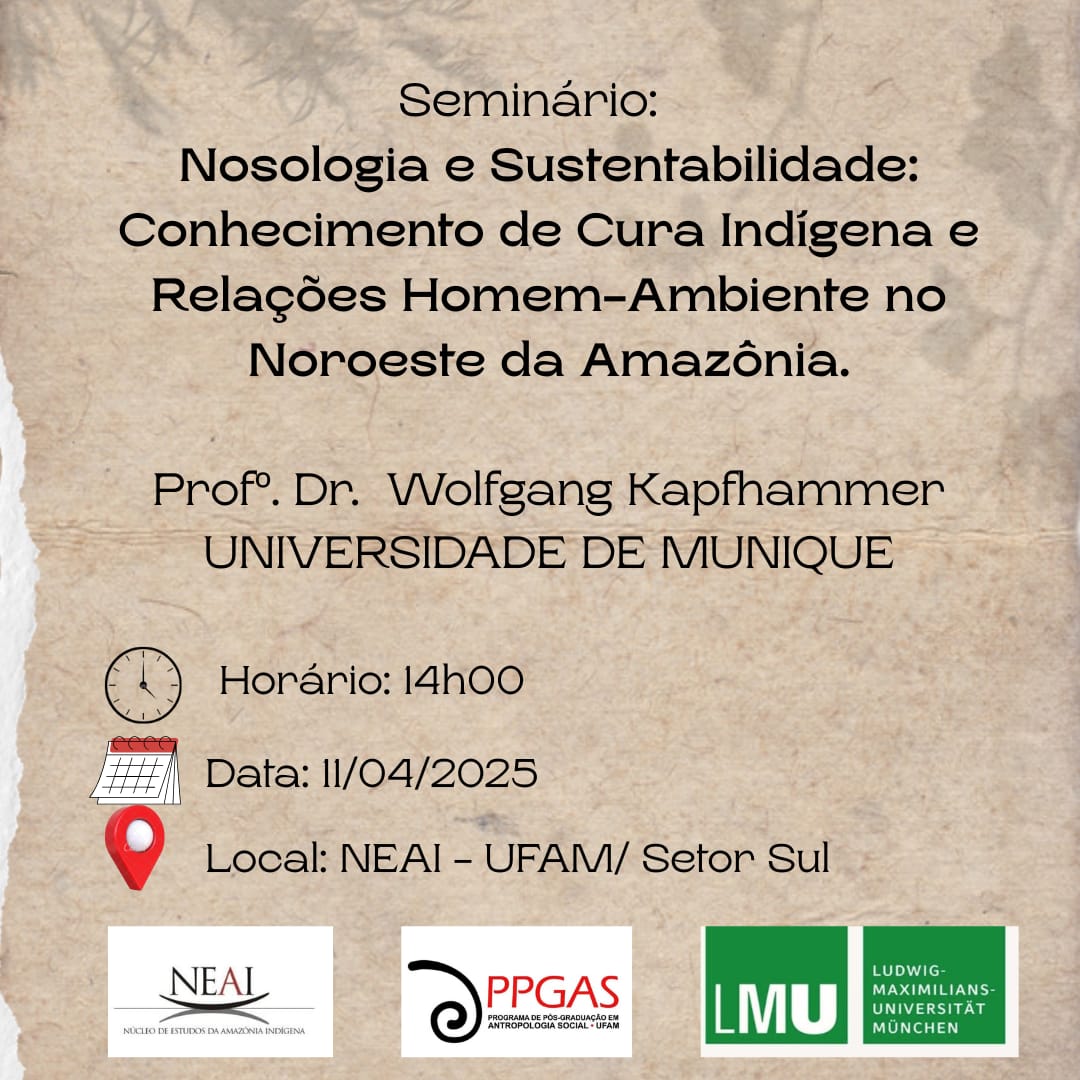
10/04/2025: 09:30 AM
Vortrag: Dereitos da Naturaleza
Vortrag von Wolfgang Kapfhammer, organisiert von Programa de Pós-graduação em Antropologia Social/PPGAS e o Núcleo de Estudos da Amazônia Indígena/NEAI.
10/04/2025: 4:00 PM – 6:00 PM
Do You Care?: Film Screenings and a Discussion About Multispecies Care
Filmmakers and Guests: Sophie Renard, Antonia Kreutzer, Johanna Löffler, Salome Fritz, Anna-Lena Friedl, and Katharina Kröner
In our sensory-multimodal research project, we explore multispecies—care relationships between humans, forests, and urban trees in and around Munich, following the stories of our protagonists through different perspectives and contexts.
Location: Rachel Carson Center for Environment and Society – LMU Munich. Leopoldstr. 11a.
More info here: https://www.carsoncenter.uni-muenchen.de/events_conf_seminars/calendar/documentary-screening/index.html
13/03/2025 – 14/03/2025
Symposium “Martius Revisited III: Global Health in a Planetary Age”

The symposium addressed the intersection of Global Health, climate change, and planetary thought. It featured lectures by the climatologists Christoph Schneider (HU Berlin) and Paulo Artaxo (USP) and brought together experts from various disciplines, as well as artists and policymakers. Highlights included panels on planetary health, multispecies cities, and decolonial ecologies -with contributions by João Paulo Tukano (UFAM), Antonio Saraiva (USP) and Eveline Dürr (LMU Munich), amongst others, as well as an interactive exhibition on planetary health and intersectional perspectives.
13/02/2025
Nosology and Sustainability: Indigenous healing knowledge and sustainable human-environment relations in Northwestern Amazonia (some preliminary thoughts)
Dr. Wolfgang Kapfhammer talks about the new project at the Center for International Health CIHLMU / LMU-Klinikum, München
24/01/2025
Lateinamerika im Fokus: Potenziale einer Weltregion

Eveline Dürr (LMU) and Benjamin Loy (LMU) moderated the round table “Lateinamerika im Fokus: Potenziale einer Weltregion” with the participation of Dr. Yaatsil Guevara González (Juniorprofessorin für “Migration and the Americas”, Universität Heidelberg), Ariel Magnus (Schriftsteller, Berlin/Buenos Aires), Jessica de Pleitez (Foreign Trade Specialist für Lateinamerika, IHK München) and Dr. Wilfredo Bernardo Ticona Cuba (Botschafter des Plurinationalen Staates Bolivien in Deutschland).
This event was organized by the LMU-Lateinamerika-Netzwerk in cooperation with the Amerikahaus München.
13/12/2024
Workshop Planetary Healing Group – CIESAS (Mexico)
Meeting between the Planetary Healing Group and Libertad Chávez Rodríguez from CIESAS, Mexico, discussing current research projects and exploring further forms of collaboration and networking.
12/12/2024
Escaping the Heat: Global Scenarios of Migration and Inequality.
Eveline Dürr (LMU) chaired the session on “Escaping the Heat: Global Scenarios of Migration and Inequality” and discussed these issues from a social sciences perspective with Libertad Chávez Rodríguez (CIESAS, Mexico) and Silja Klepp (University of Kiel).
This lecture was part of the Lecture Series “Extreme Heat. The Planetary Future” of the CAS Research Focus Planetary Health.
12/11/2024
FokusLMU: “Welt im Wandel: (De)Globalisierung heute und gestern”
Prof. Dr. Eveline Dürr talked from an anthropological perspective and provided examples of endeavors made by different societies to reverse the impacts of globalization.
Video Recording of the Event
8/11/2024 – 9/11/2024
DGSKA – Regional Working Group South America, Workshop at LMU Munich
Meret Haack: “Political Practices Revisited – Dimensions of Planetary Healing in the Context of Climate Change in Chile”
Markos Panayiotou: “Healing the Planet: The Perspectives of Kichwa Healers in Napo”