By Meret Haack (LMU München)
Approaching polyphonic[1] transformation(s)
My research topic – transformation – seemed foggy even to me until I met Mariana Cruz[2]. We had coffee in a busy mall in Santiago on a Tuesday morning in April 2025.
After some casual conversation, I explained the topic of my preliminary doctoral project: in 2022, Chileans rejected a constitutional draft proposed to replace the current constitution, which dates to Pinochet’s dictatorship. Social upheaval preceded the constitutional process, as people sought to end inequities that, according to many, stemmed from political conditions favoring free markets and privatization. The constitutional proposal declared nature a legal subject and recognized climate change as a central threat to humanity. Some saw it as a unique opportunity to preserve Chile’s natural environment, which is highly vulnerable to the effects of climate change (Jarpa Solar, 2020).
I’ve been wondering what happened to the transformative energy that drove the upheaval and the constitutional process. To understand ideas of environmental transformation, I interviewed representatives of environmental NGOs and foundations. I had a broad notion of transformation in mind that goes beyond programmatic projects of socio-ecological transformation in response to climate change. I wanted to be attentive to changes in human-environment relations that recent political events may have triggered. The protests, the propulsive events, and environmental discourses about (post)colonial relations lead me to address transformation in relation to healing in a broader sense. It’s a deeply exploratory undertaking.
By the time I met with Mariana, I had already spent some weeks in Santiago. The transformation I sought eluded me until that morning, when I saw it inscribed in her skin. As I broke the ice and introduced my topic, she rolled up her sleeve, showing me her tattoo:

She told me that she likes the word “healing”, because in English it alludes both to physical and emotional recovery and to how we relate to our world in the future. That’s why she decided to get the tattoo. In our conversation, Mariana criticized political institutions for pursuing socio-environmental transformation in territories without recognizing their particularities. According to her, these territories must be “healed” before being “transformed.”
I always thought of transformation as a prerequisite for or part of healing, but that day I wondered whether I was putting the cart before the horse. Healing and transformation suddenly became concrete. Yet grasping them and understanding their connections remains difficult. When social upheaval first started brewing in October 2019, profound change, manifested in the constitution, seemed like a common project. Five years later, cracks had emerged, revealing scattered, polyphonic transformations that continue to evolve.
Here I explore a few polyphonic and transformative ideas by focusing on three metaphors that have emerged from the interviews: 1) transformation as a collective awakening, 2) the trauma caused by the rejection of the constitutional proposal, and 3) mycelia as a metaphor for new political and social networks. These metaphors illuminate how polyphonic transformations contribute to a broader process of healing.
Chile despertó – Has entire Chile awakened?
On a sunny Friday afternoon in April in a bar in Santiago, I had coffee with my friend Ignacio, whom I had first met a couple of years prior. He shared his memories of September 3rd, 2022.
It was the eve of the referendum on the constitutional proposal. As Ignacio was telling me, supporters of the constitutional proposal gathered in large numbers, celebrating on the streets. The Alameda, one of Santiago’s main roads, was crowded with supporters. “We got this!” They thought it was a sure thing. After former student leader Gabriel Boric won the presidency in November 2021, forming a transformative government[3] (Peña and Silva, 2023), even government institutions seemed to have caught the transformation bug. Ingnacio’s story echoed what I had read and heard about the protests: a clear will for change and confidence of victory. “Chile despertó” (Chile has awakened) was the protestors’ favorite slogan, and it indicates the profound change people were expecting.
The day after the premature victory celebration, as related by Ignacio, the constitutional proposal was rejected by a clear majority (Larrain et al., 2023). Five years later, I was certain that I would find traces of transformation.
I arrived on a typically hot Santiago summer morning. I got off the subway and walked past Plaza Italia, a grand central square in downtown Santiago. In October 2019, it was renamed Plaza Dignidad (Márquez, 2020). It was a locus of the protests. The iconic pictures of protesters conquering the statue of General Baquedano went viral globally.
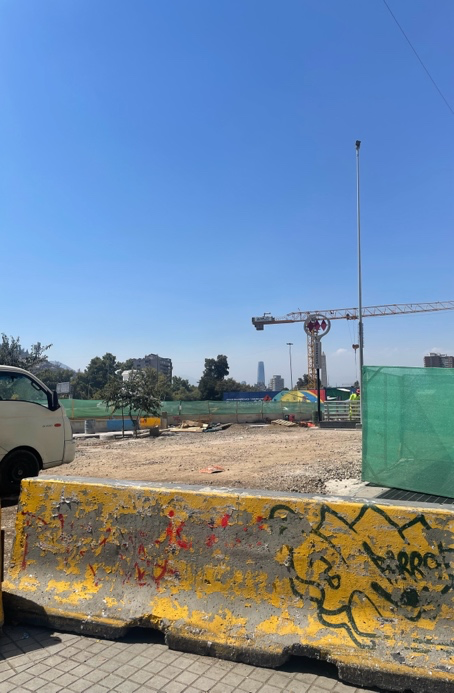
I had expected to find traces of transformation on the streets, but I found none. What I saw instead was a massive construction site. No flags, no signs, and even the statue of Baquedano was gone. The sun was scorching, and traffic raised its typical din in the background. On the streets, there was no sign of collective awakening and transformation left. Maybe the traces I sought would be in the conversations I would have.
From awakening to trauma
After arriving at my new home, a shared flat just one block away from Plaza Italia, I had breakfast with my roommate, telling her about my research plans. “No one wants to talk about this anymore,” she said. Living in this neighborhood during the protests, witnessing all the demonstrations, the police violence, and the unrest was crazy. But things had gotten very calm, she said. “Do you know about the statue?” I asked. “I’m not sure”, she said. “I think they brought it to a museum.”
A few days after my arrival, I started conducting my first interviews.
In a speech after his victory in the 2021 primaries, Gabriel Boric affirmed: “If Chile was the cradle of neoliberalism, it will also be its tomb.” (cervando oratetv, 2023). However, my interviewees experience that neoliberalism is still alive. According to some of them, things are even worse now than before. Even worse? How so?
According to Pamela Poo, who works at a foundation promoting socio-ecological transformation from the Global South, the current government “cast the foundation of capitalism.” At the same time, she was referring to a global phenomenon: capitalism has co-opted carbon neutrality in that it is often achieved (when it is achieved at all) at the expense of the Global South. Power imbalances are reproduced, disadvantaging countries like Chile that export resources. Extractivism as a mode of production continues, even as its products are labeled “green” and “clean.”
After the interviews, I found myself asking: Has 21st-century “green” capitalism buried transformation? My interlocutors vividly described how environmental issues have lost significance since the social unrest.
The pandemic and other political issues have come to dominate the government’s agenda, crowding others out. Chile’s environmental regression results from the crisis of capitalism and shock therapy, as Pamela puts it, borrowing from Naomi Klein, referring to the retraction from the protesters’ progressive agenda.
The current government seems to define its vision of transformation in the framework of capitalism, but, as several of my interview partners stated, without considering local communities and the territories affected by extractivism.
Can transformation be at once common and sensitive to local concerns?
This question brings me back to the image of transformation as a collective “awakening.” Various retrospective analyses cast doubt on the popularity of transformation and attempt to explain why the constitutional process failed (Sazo, 2023). Among my interviewees, too, there is no consensus on how realistic the constitutional project was. Unlike my friend Ignacio, some, like Pamela, were certain that fake-news campaigns by industrial interests would doom the draft.
Others, such as Christian Sánchez, considered some of the radical claims by the ecologist faction of the constitutional convention to evidence their political detachment. By contrast, Gabriela Cabaña held the narrative of the draft to be “extremist,” a “collective hallucination” cast retrospectively.
There is and was no consensus on what transformation means, where it should aim, whether it should be achieved gradually or suddenly, and whether the constitution was the right vehicle for it in the first place.
Still, my interlocutors did agree that the failed constitutional process induced trauma on the environmental movements. Trauma of what? “It’s like in this meme where this figure tries to reach the ball but is stopped at the last moment. Like being super close to something but then seeing it go overboard,” as Gabriela described. How is this trauma affecting the environmental movements and progressive politics? “Estamos en plena resaca.” (We are now facing the backwash), is how Christian framed the current state of the environmental agenda in Chile. The protests and the collective awakening they foresaw were a powerful (transformative) wave, but the backwash was even stronger. In light of the polyphonic transformative traces, maybe the image of smaller currents carrying transformation is more suitable than one big wave.
Mycelia: Transformation as relation and reconnection
Anyone who’s suffered trauma must sooner or later face the question of how to move on. So how can Chile’s environmental movements and actors move on in the wake of the trauma caused by the constitutional proposal’s rejection? Recovering from trauma is a form of healing, so it makes sense to return to the notion of relation that came up talking to Mariana about her tattoo. The relational potential of transformation might be a response to trauma.
My interviewees unanimously emphasized the urge to reconnect local realities with politics and environmental movements. Drawing on their experiences with local communities in areas affected by lithium mining and other more traditional extractive practices, they criticized state policies that ignore the needs of communities.
According to Mariana, the disconnection between territory and politics is rooted in the legacy of the dictatorship. Thatregime robbed people of the ability to relate to their history and environment. She emphasized that there is no value in romanticizing the past—those times when streets were unpaved and people supposedly lived in harmony with nature. Instead, the challenge lies in thoughtfully considering what aspects of the past are worth recovering and how they might be brought into dialog with future visions. Contradictory as it may seem, reconnecting with the past could be a powerful impulse and temporal framework for transformation.
As Chile matches 7 out of 9 criteria of vulnerability to the effects of climate change (Jarpa Solar, 2020), pragmatic approaches are necessary. Pamela, for instance, used the metaphor micelios (mycelia, the web-like structure formed by spreading fungus) to suggest a form of politics that is neither top-down nor bottom-up but relies on local networks capable of responding to local challenges. These mycelia are another transformative path, as they suggest another practice of reconnection, reconciling political pragmatism and governance with local realities.
Transformation remains foggy. The fragments from the interviews show that transformation in each term of Chile’s current environmental agenda is being negotiated – how, where, and by whom it is to be achieved.
Contrary to the idea of a collective awakening or the universal character of a constitutional project, transformations are indeed polyphonic, occurring on various levels, pursued by different actors. Transformations may become apparent in efforts to reconnect and recalibrate local needs and conditions alongside political demands and goals. This may ultimately trigger healing processes in a broader sense, particularly as they relate to a reconfiguration of human-environment relations.
Acknowledgments
I am deeply grateful to my interviewees for their time, openness and for sharing their inspiring thoughts and ideas with me. I would also like to thank Ben Kamis for his careful editing and valuable suggestions that helped improve the clarity of this text.
The research was conducted within the framework of the Reinhart Koselleck project “Planetary Healing: Transformation, (De)colonization and Climate Change” and was funded by the German Research Foundation (Deutsche Forschungsgemeinschaft) – 529294330.
References
cervando oratetv. (2023).“Gabriel Boric y La Tumba Del Neoliberalismo”. Available at: https://www.youtube.com/watch?v=kjHnDUVA4GA [Accessed: 10 September 2025].
Jarpa Solar, María José. (2020). ‘La Vulnerabilidad de Chile Frente al Cambio Climático’, Www.cr2.cl. Center for Climate and Resilience Reserach (CR2), Available at: https://www.cr2.cl/la-vulnerabilidad-de-chile-frente-al-cambio-climatico-el-desconcierto/ [Accessed: 4 November 2025].
Larrain, Guillermo, Gabriel Negretto, and Stefan Voigt. (2023). ‘How Not to Write a Constitution: Lessons from Chile’, Public Choice, 194(3–4), 233–47. https://doi.org/10.1007/s11127-023-01046-z.
Márquez, Francisca. (2020). ‘Por una antropología de los escombros. El estallido social el Plaza Dignidad, Santiago de Chile’, Revista,180(45), 1–13. http://dx.doi.org/10.32995/rev180.Num–45.art–717.
Peña, Carlos, and Patricio Silva. (2023). ‘El Gobierno de Boric y Su Impronta Transformadora’, in: Carlos Peña and Patricio Silva (eds), El Gobierno de Gabriel Boric. Entre Reforma y Refundación (Santa Isabel: Editorial Catalonia Ltda).
Sazo, Diego. (2023). ‘CHILE 2022: From Great Expectations to Rising Pesimism’, Revista de Ciencia Política (Santiago), 43, 193–222. https://doi.org/10.4067/s0718-090×2023005000118.
[1] According to the Cambridge dictionary, the word polyphonic means “consisting of several different tunes that are played or sung at the same time“. This post, though not focused on music, addresses the plurality of perspectives, voices and stances that shape transformative ideas, perceptions and movements regarding the environment in Chile.
[2] The names mentioned in the text are the real names of the interviewees, who gave their explicit consent to use them in this publication.
[3] A few days after the publication of this text, elections will take place in Chile, and Gabriel Boric will be succeeded by a new president.
Cite as: Haack, Meret (2025). ‘From “Wave” to “Mycelia”? Reflecting Notions of Transformation and Healing in Chile’s Environmental Agenda’, Planetary Healing Blog, url: https://www.planetaryhealing.gwi.uni-muenchen.de/from-wave-to-mycelia/