By Christopher Klapperich (LMU München)
Turning Towards Trees
Native trees are trending on social media in the Philippines. In various Facebook groups, so-called native tree enthusiasts are sharing information about and photos of Philippine tree species. Some show the trees they recently planted, others upload pictures of blooming trees in their neighborhood that they would love to grow, but cannot identify. This interest in native plants and trees is a rather recent phenomenon in the Philippines. While native trees have rarely been planted for most of the last century, they have received more attention over the last decade. During the pandemic, caring for plants became a widespread hobby, which was highlighted by newspaper reports covering the new interest of the so-called “plantitos” and “plantitas” as part of the“plantdemic” (Guiang, 2020; Lim and Lasco, 2020). Trying to understand why native trees have been neglected in Philippine reforestation, I quickly became interested in the native tree enthusiasts’ advocacy and accompanied them during educational tree walks, monthly meetings, and other activities in which they highlight the relevance of almost forgotten tree species. In addition to organizations like the Philippine Native Plants Conservation Society, Inc., and scientific institutes like the Institute of Tropical Ecology and Environmental Science at Visayas State University, the enthusiast groups have become a central voice in promoting native trees in Philippine reforestation. The enthusiasts’ backgrounds and professions vary; what unifies them, however, is their interest in the over 3,600 tree species that once made up almost 90% of the Philippine landscape. Yet, due to intensive commercial logging and planting of exotic monocultures, many of those 3,600 tree species, as well as the knowledge on how to care for them, have become rare. Caring for native trees, therefore, is an ongoing learning process, but one that contributes to conserving those trees for the future, as many interlocutors expressed.
Reconfiguring human-plant relations – be it through multi-sensorial attention to plant life on the individual level or by questioning human-plant relations that constitute the Anthropocene – has a transformative potential (Myers, 2021). This transformative potential is also ascribed to (planetary) healing practices, specifically as they connect different temporal and geographical scales (Middleton, 2010: 11; Dürr and Rohrer, 2022: 158). So far, contributions to healing have often focused on case studies in which discourses around what has been lost and how people have been affected by colonial powers were already established (Valandra, 2005; Middleton, 2010; Tironi and Rodríguez-Giralt, 2017; Johnson and Sigona, 2022). Reflecting on my research on native tree advocacy in the Philippines, I wonder to what degree everyday interactions or engagement with plants can be described as healing practices, especially in cases in which decolonial discourses of reconciliation, justice, or the planetary dimension are not very present. Although not explicitly addressed, everyday aspects of these discourses might have implicitly guided an interest towards plants in the first place.
According to political ecologist Elisabeth Middleton (2010: 11), “healing includes personal efforts to acknowledge the effects of historical trauma in multiple aspects of one’s life relationships (…)”. But what if people have grown up in, and have therefore normalized, deeply transformed landscapes? What if the effects and traumas of colonization and its landscape transformations are not articulated? Do healing practices require a certain degree of scale-making, of acknowledging suffering, damage, or loss, to be conceptualized as such? Are there prerequisites for healing in an altered archipelago? Inspired by the fruitful exchange of the symposium “Healing in the Damage: Novel Perspectives on Human-Environment Entanglements” held on June 6, 2025, at Ludwig-Maximilians-Universität München, this blog post continues the discussions by reflecting on the limits of scale-making often associated with (planetary) healing. Paying attention to historical landscape transformations and how they have become normalized in everyday life, as I argue, has the potential to become attentive to rather implicit or explorative ways of planetary healing practices.
Colonial Forest Transformations
The Philippines, with its over 7,000 islands, is one of the world’s mega-diversity countries and a biodiversity hotspot (Heaney et al., 2004: 179). Over 3,600 tree species are native to the archipelago. Once covered 90% with rainforests, the Philippines lost 20% to 40% of its forest cover during the Spanish colonization (Kummer, 1992: 45; Bao, 2012: 118). In the 20th century, big logging companies opened up the densely forested uplands to which more and more people migrated, searching for better livelihood conditions in a continuously growing country (Kummer, 1992: 93 f.). Today, with only 24% of forest cover and 3% of old-growth forests left, agricultural land and coconut monocultures dominate the landscape (Lasco et al., 2001: 653). Next to colonial forest transformation, which made the landscapes more prone to landslides or flashfloods, typhoons and other extreme weather eventsincreased in the last decades, leading to numerous deaths every year. Yet, the mainly colonial forest transformations affect not only native tree reforestation efforts but also potential healing practices.
One of the commonalities of the Spanish and U.S. colonial periods in the Philippines is their focus on valuable Philippine tree species, specifically dipterocarp trees. While the Spaniards introduced several trees and vegetables, they mainly logged dipterocarps and other native trees suitable for shipbuilding before establishing a domestic timber market in the late 19thcentury (Baguinon et al., 2005: Bankoff, 2007). Building on the Spanish forestry efforts, the U.S. colonial administration tried to implement more rigorous and modern forestry approaches. One obstacle, however, as George Patrick Ahern, the first director of the Bureau of Forestry in the Philippines, emphasized in his writings, was “a great variety of tree species” (Ahern, 1901: 54). It is no surprise, therefore, that the Bureau of Forestry started to experiment with well-studied exotic tree species like mahogany or teak from early on. While experimenting with mahogany from South and Central America, Philippine dipterocarp forests remained the primary source of export timber. Yet, the various Philippine dipterocarp trees were rarely traded under that name on international markets. Instead, they were traded as “Philippine mahogany” – a tree species that did not exist in the Philippine archipelago. Selling various dipterocarp species under the name of “Philippine mahogany”, thereby linking lesser-known tree species to highly praised mahogany woods, turned out to be a highly successful marketing trick that contributed to the huge timber exports throughout the 20th century.
The low and uplands of the country, however, became more and more degraded. Even though tree planting was never prioritized in the forestry sector and research on reforestation was “still in its infancy” (Glori, 1973: 3), large-scale reforestation was seen as the solution to revitalize the declining logging sector and to make barren lands productive again. Due to the limited research on native trees and the urgency to reforest as quickly as possible, the first national reforestation program in the 1980s focused heavily on exotic tree species as they were internationally known to be fast-growing. In the following years, exotic tree species such as mahogany (Swietenia macrophylla), gmelina (Gmelina arborea), acacia (Acacia mangium), and eucalyptus (Leucaena leucocephala) were not only planted in degraded forests, watersheds, and hillsides but also nursed in many commercial tree nurseries across the country for future reforestation. As a result – and despite the vigorous advocacy for native tree species by environmental NGOs and scientists in the 2000s – the environmental authorities have again mainly used a small variety of exotic tree species in the recent nationwide reforestation program launched in 2011. In the end, 86% of all planted trees were exotic tree species.
Normalizing Altered Landscapes
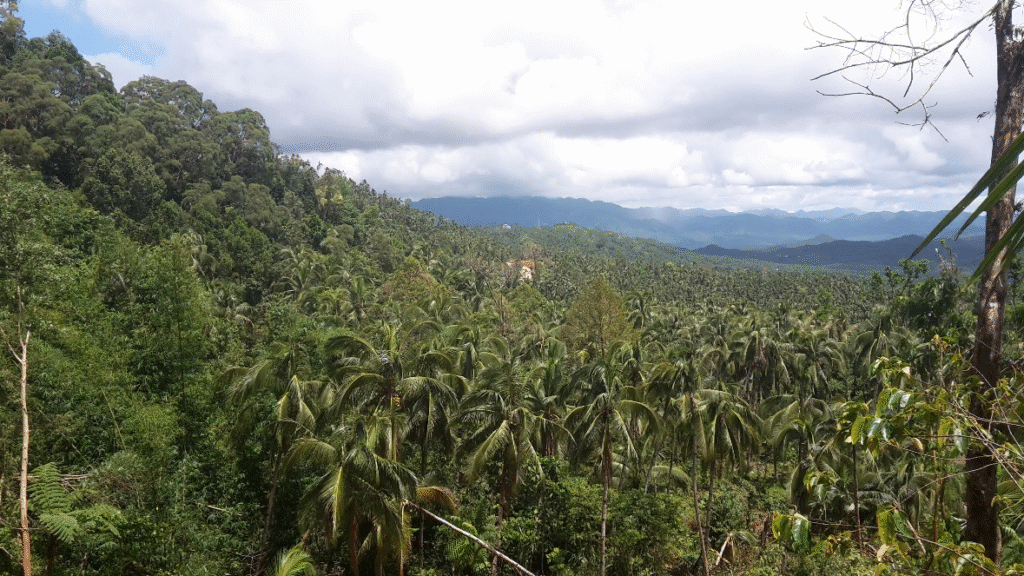
The centuries of landscape transformations are clearly visible in the Philippines today. Thousands of hectares of coconut monocultures stretch across the uplands in the Visayas, next to fragmented forest patches reforested with exotic monoculture. Yet, these landscapes, as well as the colonial past, are rarely questioned; they have become normalized. Today, the coconut tree has become emblematic of the area around Baybay, Leyte, exemplified by tourism webpages that have integrated the coconut into their logo, and in Bohol, man-made mahogany forests have become landmarks, attracting thousands of tourists. However, mahogany trees are not only prevalent in the landscape but also one of the first associations with reforestation for many people I talked to who were not involved in (native) tree planting. Throughout these conversations, I realized that mahogany was mentioned so often not only because it was commonly used in reforestation and known as fast-growing, but also because it was believed to be native due to the umbrella term “Philippine Mahogany” under which the various dipterocarp trees were sold. In fact, even foresters and universities had adopted the term in the 20th century, thereby further reinforcing the blurring of native and exotic species classifications. Scientific books depicted what they called “a typical Philippine mahogany forest” (Tamesis and Aguilar, 1953: 11), and governmental brochures listed Philippine habitats as seed sources for mahogany and otherexotic tree species (ERDB, 1992). That people regularly mention mahogany in conversations about tree species but do notknow much about the different dipterocarps that were subsumed under “Philippine mahogany” was also addressed by Ronald Achacoso[1], artist and native tree advocate of the Philippine Native Plants Conservation Society, Inc.:
“But it’s also our mindset that, because it [mahogany] was introduced to us and we know it, we know the name and we know its virtues, we started planting them everywhere. (…) Since it has a name and since (…) people gave you the name and they tell you it’s hardwood, anything else without a name has no value, you know. Sadly, we have forgotten our traditional knowledge, so we’ve forgotten the names of the plants. We’ve lost the link, the psychic connection. (…) Unfortunately, we name exotics but disregard all the natives. All the 3,600 species that we have.”
While coconut and exotic tree monocultures replaced lush forests across the archipelago, names, knowledge, and the link, as Ronald Achacoso emphasized, to native tree species have been diminished. Trees that have the potential to mitigate extreme weather events and to improve the soil of a landscape haunted by landslides and flash floods. But the vegetation, as well as the wounds that the extreme weather events frequently cut into the uplands, have become normalized, too. While the frequency of disasters leaves almost no room for mourning, logging is the only identified culprit. How to reforest, to restore the degraded landscape, is rarely debated. Yet, Robin Wall-Kimmerer (2020) reminds us that the state of our environment is a mirror of our relation to it: Referring to Gary Nabhan, she further states that “we can’t meaningfully proceed with healing, with restoration, without ‘re-story-ation’”[2] and that “our relationship with land cannot heal until we hear its stories. But who will tell them?” (Kimmerer, 2020: 9)
Explorative healing?
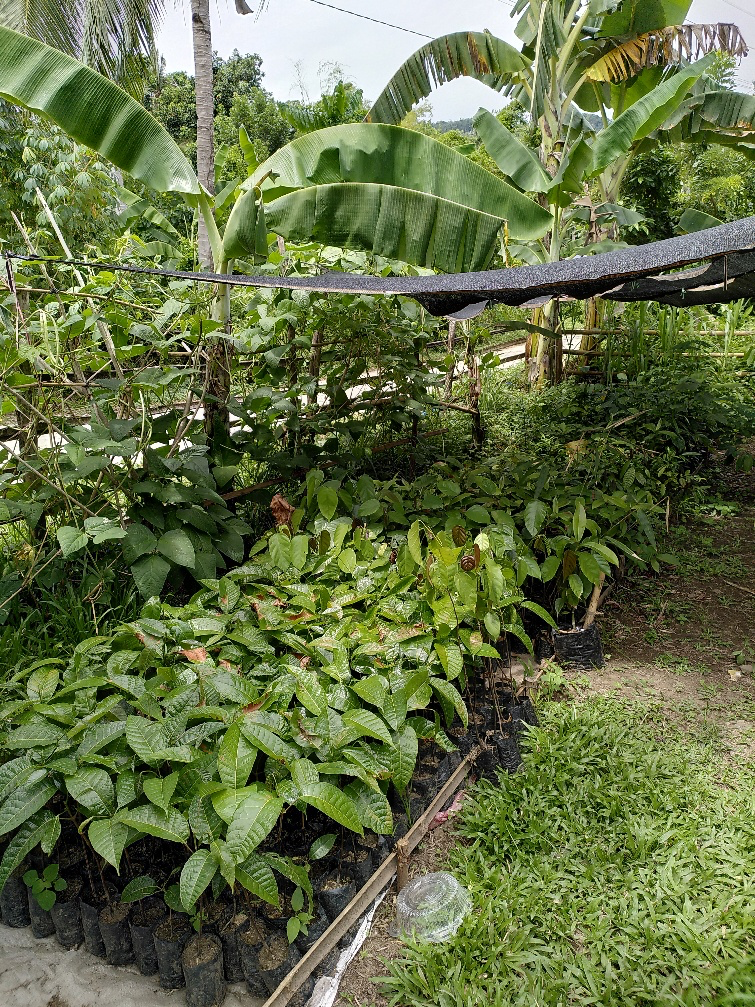
“Philippine Native Tree Enthusiast” was written on Teza Ramos’ dark green shirt as she stood in front of twenty students in a packed classroom in Southern Leyte. Teza was invited to talk about native trees and their relevance to kick off a tree planting project on campus. I sat in the back, accompanying her to understand how native tree enthusiasts advocate for native tree species despite the huge emphasis on exotic trees in Philippine reforestation. Going through her slides and illuminating the role of biodiversity, Teza asked the group of students if they knew any native trees. One student raised her arm and said, “narra” (Pterocarpus indicus), the Philippines’ national tree; another student mentioned molave (Vitex parviflora). Then, gmelina (Gmelina arborea) and acacia (Acacia mangium) were named by fellow students – two exotic tree species, as Teza pointed out. She was not surprised to hear only two native trees before the first exotic tree was mentioned, as she explained to me afterwards. In contrast, exotic tree species would often be confused for being native. After waiting for further comments, Teza asked the students where they came from. As the students mentioned different village names, Teza pointed out that several of thenames were not only villages but also native tree species. Trees that were once predominant in the landscape but disappeared as the archipelago has been altered.
Teza is one of the more engaged native tree enthusiasts I have met. Like some of the other members, she has established her own native tree nursery and meets her fellow tree enthusiasts monthly to exchange seeds or plant trees. But she is also very engaged outside of the group, like on the morning when she stood in front of the packed classroom. Visiting schools and hearing the same responses over and over again, she decided to act upon the loss of connections to the previous landscape, as she described on Facebook:
“Maasin City, So. Leyte, where I am from, has 9 barangays [barrios] named after Philippine flora. (…) You can imagine the abundance of these trees in those areas in the yesteryears. Today, you rarely see on. And most residents wala [have no] idea of the history how the names came about, nor they care to ask. For more than a year now, I have been preparing for a project which I call Balik Kahoy Initiative. I have been growing seedlings of these trees to grow them back in these areas (…).”
Bringing back the memory of the landscape that is still present in the names of the barangays by planting the trees that previously belonged to the landscape, Teza’s initiative is certainly one of the few explicitly addressing the loss of relations brought by colonial forestry. While Teza’s posts and initiatives have the potential to create awareness for the strangeness of the current landscape, most enthusiasts I met focus solely on the trees themselves. As their backgrounds and professions differ, some simply want to plant native trees in their gardens or share them with their neighbors. Others care for native seedlings in their nurseries right next to exotic tree species they like. What many of them have in common, however, is that they were first interested in birds or insects, realizing that their numbers decline due to habitat loss, and subsequently became interested in native trees – which is also highlighted by information material of bee-friendly trees or bird-friendly trees that they have published over the years. Yet, colonial forest transformations, biodiversity loss, or climate change were not the focal point of most of my conversations. Rather, the current landscape often seemed like a neutral given. A landscape that makes sourcing native seeds challenging, but one that the enthusiasts have to deal with, as it was already transformed before they were born.
Referring again to Elisabeth Middleton’s (2010) conceptualization of “healing” as a practice in which people actively address and personally acknowledge “historical traumas”, healing seems to require a certain effort or engagement with what has been damaged and lost. This kind of scale-making, geographically or temporarily, was not articulated in most of the conversationsI had. However, the fact that more and more people have dedicated their time to caring for native trees and to growing them in their backyards, also during the pandemic, might indicate a rather implicit way of healing. Turning to plants, many of the native tree enthusiasts I talked to started to rethink human-plant relations and their relation to a landscape of the past, which they hadnever known and therefore never longed for.
How do we conceptualize interests in vegetal life that might be emblematic for our current times (also in the humanities, see e.g., “vegetal turn”) but that do not (yet) address the historical and contemporary traumas that (neo)colonialism provokes? What if intergenerational traumas are normalized and therefore not articulated? What if people live with a damaged landscape but don’t address its roots? Are these forms of silent or explorative healing?
References:
Ahern, George Patrick. (1901). ‘Special Report of Captain George P. Ahern in Charge of Forestry Bureau, Philippine Islands, Covering the Period from April, 1900, to July 30, 1901’ (Washington: Division of Insular Affairs, War Department. Govt. Print. Off).
Baguinon, Nestor T., Marylin O. Quimado, and Genesis J. Francisco. (2005). ‘Country Report on Forest Invasive Species in the Philippines’, in: The Unwelcome Guests: Proceedings of the Asia-Pacific Forest Invasive Species Conference, Kunming, Yunnan Province, China, 17-23 August 2003. Food and Agriculture Organization of the United Nations, Regional Office for Asia and the Pacific.
Bankoff, Greg. (2007). ‘One Island Too Many: Reappraising the Extent of Deforestation in the Philippines Prior to 1946’,Journal of Historical Geography, 33, 314–34.
Dürr, Eveline, and Ingo Rohrer. (2022). ‘Planetary Healing: A New Approach to the Challenges of Climate Change’, Sociologus. Journal for Social Anthropology, 72(2), 157–64.
ERDB. (1992). ‘Distribution and Site Requirements of Some Reforestation Species’, (Laguna, Philippines: No. 4. RISE Research Information Series on Ecosystems).
Glori, Antonio. (1973). ‘Some Problems and Needs of Reforestation Research in the Philippines’, Conservation Circular, 9(8), 1–4.
Guiang, Jules. (2020). ‘“Plantdemic” Hits Philippines as Demand for Greenery Grows’. RAPPLER, November 9. Available at: https://www.rappler.com/environment/nature/plantdemic-hits-philippines-demand-greenery-grows/. [Accessed 23 September 2025].
Johnson, Adrienne, and Alexii Sigona. (2022). ‘Planetary Justice and “Healing” in the Anthropocene’. Earth System Governance, 11, 100128.
Kimmerer, Robin Wall. (2020). Braiding Sweetgrass: Indigenous Wisdom, Scientific Knowledge and the Teachings of Plants (Penguin Books).
Lasco, Rodel, Roberto Visco, and Juan Pulhin. (2001). ‘Secondary Forests in the Philippines: Formation and Transformation in the 20th Century’. Journal of Tropical Forest Science, 13(4), 652-670.
Lim, Theresa Mundita, and Gideon Lasco. (2020). ‘“Plantitos,” “Plantitas,” and the Environment’. INQUIRER.Net, October 6. Available at: https://opinion.inquirer.net/134199/plantitos-plantitas-and-the-environment. [Accessed 23 September 2025].
Middleton, Elisabeth. (2010). ‘A Political Ecology of Healing’, Journal of Political Ecology, 17 (1), 1-28.
Tamesis, Florencio, and Luis Aguilar. (1953). ‘The “Philippine Mahogany” and Other Dipterocarp Woods’, Popular Bulletin, 44. Bureau of Printing.
Tironi, Manuel, and Israel Rodríguez-Giralt. (2017). ‘Healing, Knowing, Enduring: Care and Politics in Damaged Worlds’, The Sociological Review, 65(2), 89–109.
Valandra, Edward. (2005). ‘Decolonizing “Truth:” Restoring More than Justice’, in: Wanda D. McCaslin (ed.), Justice as Healing: Indigenous Ways (Living Justice Press).
[1] With the permission of my interlocutors, I use their real names in this blog post.
[2] For another account of the potential of “re-story-ation” in Philippine restoration, see Angie Hsu’s forthcoming article.
Cite as: Klapperich, Christopher (2026). Bringing Back Native Trees: Healing Colonial Forest Transformations in the Philippines, url: https://www.planetaryhealing.gwi.uni-muenchen.de/bringing-back-native-trees-healing-colonial-forest-transformations-in-the-philippines/